

Patient assessment is a cornerstone of respiratory therapy and an essential topic on the board exam. It tests your ability to gather and interpret clinical data, recognize abnormal findings, prioritize care, and recommend the most appropriate intervention for a given patient scenario.
A strong understanding of patient assessment principles is important not only for exam success but also for delivering safe, effective, and timely respiratory care in clinical practice. Many board exam questions are built around assessment findings, which means you must be able to connect the clues in the question stem to the patient’s underlying problem.
In this guide, we’ll cover practical tips and high-yield strategies to help you confidently approach patient assessment questions on the board exam. By mastering these concepts, you’ll be better prepared to make sound clinical decisions and move one step closer to earning your RRT credentials.

Take our free course to learn essential tips, insights, and strategies to pass the TMC Exam on your first (or next) attempt.
Why Patient Assessment Is Important for the Board Exam
Patient assessment is one of the most important topics on the respiratory therapy board exam because it forms the foundation of clinical decision-making. Respiratory therapists must be able to evaluate vital signs, recognize abnormal breath sounds, identify breathing patterns, and interpret physical assessment findings to determine the patient’s condition.
Many exam questions are built around clinical scenarios that require you to analyze assessment data and choose the most appropriate intervention. This means that success on the board exam often depends on your ability to recognize patterns and connect symptoms with the underlying problem.
By mastering patient assessment concepts, you’ll not only improve your exam performance but also develop the critical thinking skills needed to deliver safe and effective respiratory care.
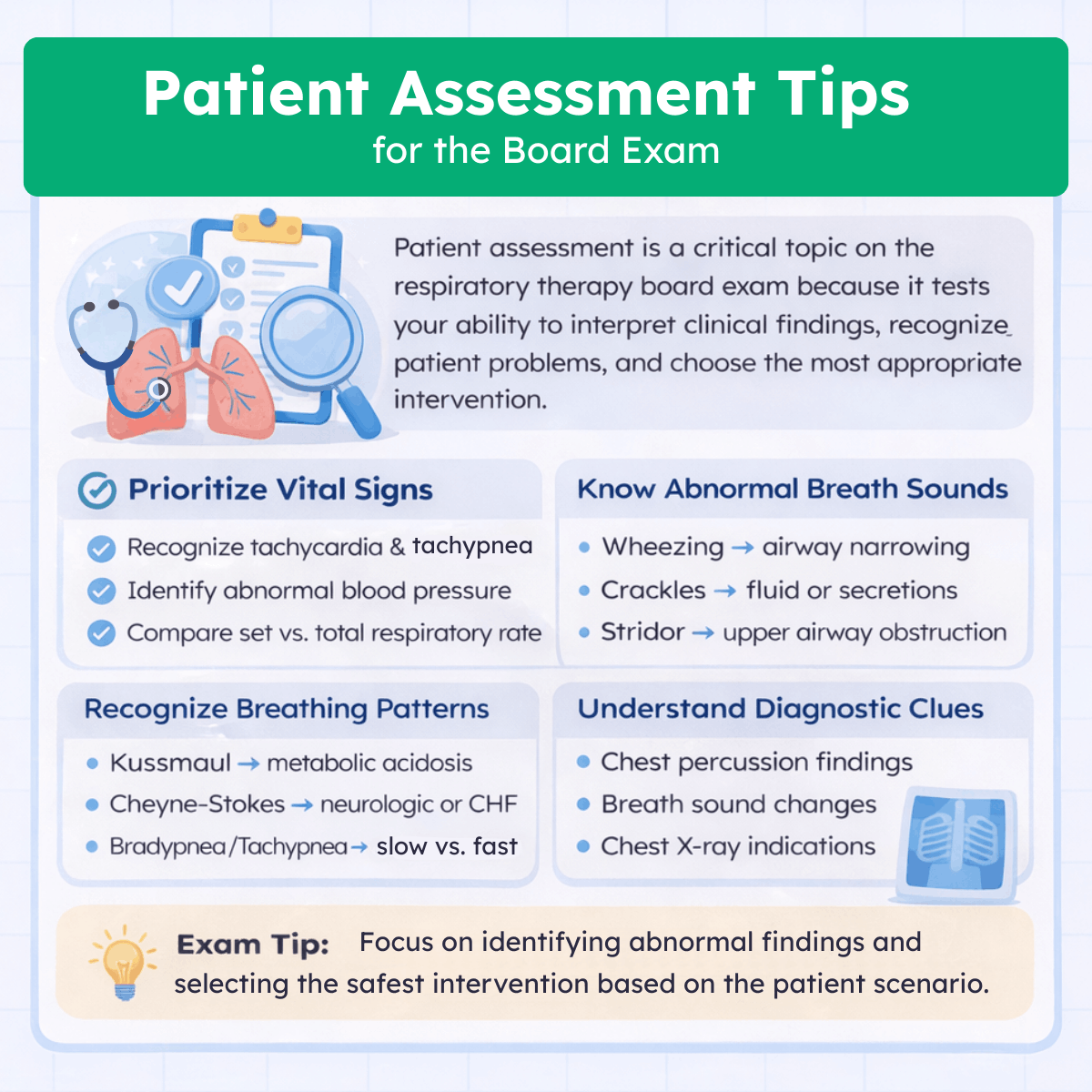
Patient Assessment Tips for the Board Exam
- Know how to interpret vital signs
- Understand abnormal breath sounds
- Understand abnormal breathing patterns
- Master chest percussion notes
- Know when to recommend a chest x-ray
Watch this video and keep reading to learn essential tips and strategies for mastering patient assessment questions on the board exam.
1. Know How to Interpret Vital Signs
Understanding how to interpret a patient’s vital signs is one of the most important patient assessment skills you can develop for the board exam. You will likely encounter multiple questions that present heart rate, blood pressure, respiratory rate, temperature, and oxygenation data, then ask you to determine what is happening with the patient and what action should be taken next.
In many cases, the correct answer is not based on a single abnormal value. Instead, you must recognize the overall pattern and relate it to the clinical situation. This is why vital signs should never be interpreted in isolation. The board exam often rewards the candidate who can identify trends, connect them to the patient’s condition, and choose the most logical next step.
Let’s look at a common example:
Example Question
A 58-year-old male in the ICU recently had a chest tube inserted to drain fluid from a pleural effusion. He is receiving mechanical ventilation with basic settings and displays the following vital signs:
- Heart rate: 120/min
- Blood pressure: 137/95 mmHg
- Set respiratory rate: 10/min
- Total respiratory rate: 29/min
- Body temperature: 99.2°F
Taking everything into consideration, which of the following would you recommend?
A. Assess the patient for pain
B. Administer a paralytic agent
C. Ask the patient to relax
D. Reposition the chest tube
Explanation
To answer this question correctly, you must analyze the vital signs within the context of the patient’s recent procedure and current condition.
- The heart rate is elevated at 120/min, which indicates tachycardia.
- The total respiratory rate is much higher than the set ventilator rate, suggesting that the patient is breathing over the ventilator.
- The blood pressure is also elevated at 137/95 mmHg, indicating mild hypertension.
When these findings are viewed together, they suggest that the patient is experiencing distress. Since the patient recently underwent a chest tube insertion, pain is a very likely cause. This is especially important because mechanically ventilated patients may not be able to clearly communicate discomfort, even when they are experiencing significant pain.
In this scenario, assessing the patient for pain is the most appropriate recommendation. Pain commonly leads to tachycardia, tachypnea, elevated blood pressure, and agitation. Treating or addressing the source of discomfort is more appropriate than jumping straight to a more aggressive intervention.
Administering a paralytic agent would not be the correct first step because paralytics may reduce visible movement but do not treat pain or anxiety. Asking the patient to relax is not an adequate intervention for postoperative discomfort. Repositioning the chest tube would only be considered if there were evidence of malposition, poor drainage, or another mechanical problem, and this would generally require imaging confirmation first.
Correct Answer: A. Assess the patient for pain
How to Approach Vital Sign Questions on the Board Exam
When you see vital signs in a question stem, slow down and interpret each value before looking at the answer choices. Then ask yourself what the overall picture suggests.
- Look for patterns: Tachycardia, tachypnea, hypertension, fever, and low oxygen saturation often point to stress, pain, infection, hypoxemia, or worsening respiratory status.
- Compare related values: For example, comparing the set respiratory rate to the total respiratory rate can reveal distress, anxiety, pain, or patient-ventilator asynchrony.
- Consider the clinical context: Postoperative patients may have pain. Patients with fever and crackles may have pneumonia. A trauma patient with hypotension and tachycardia may be in shock.
- Choose the least invasive appropriate action first: The best answer is often the one that addresses the most likely cause while following good clinical judgment.
Common Vital Sign Patterns to Recognize
- Tachycardia + tachypnea + anxiety: Think pain, hypoxemia, fever, or respiratory distress.
- Bradycardia + hypoventilation: Consider sedation, drug overdose, or severe neurological impairment.
- Fever + increased respiratory rate: Consider infection, sepsis, or increased metabolic demand.
- Hypotension + tachycardia: Think shock, bleeding, dehydration, or sepsis.
- Hypertension + agitation: Consider pain, anxiety, or inadequate sedation.
Key Takeaway for the Board Exam
You will be expected to interpret vital signs quickly and accurately on the board exam. Success comes from identifying abnormal patterns, understanding what they mean in the clinical setting, and selecting the intervention that best addresses the patient’s immediate problem.
- Identify trends: Look for combinations of abnormal findings rather than focusing on one value alone.
- Use the context: The patient’s diagnosis, setting, and recent procedures often tell you why the vital signs are abnormal.
- Eliminate poor choices: Remove answers that are too aggressive, unrelated, or unsupported by the assessment findings.
Note: By strengthening your ability to interpret vital signs, you’ll be better equipped to answer patient assessment questions on the board exam and make sound clinical decisions in practice.

Access our quiz, which includes sample TMC practice questions and detailed explanations to help you master the key concepts of patient assessment.
2. Understand Abnormal Breath Sounds
Mastering the different types of abnormal breath sounds is essential for the board exam. These sounds frequently appear in clinical scenarios, and your job is to identify what the sound suggests about the patient’s condition and determine the most appropriate response.
The key is not just memorizing names. You must understand what causes the sound, where it is usually heard, and what treatment or intervention is most appropriate based on the rest of the clinical picture.
Wheezing
Wheezes are high-pitched whistling sounds caused by airflow moving through narrowed airways. They are often heard during expiration, although they can sometimes be heard during inspiration as well.
Wheezing usually points to airway narrowing, but the cause of that narrowing matters.
Common causes and treatments:
- Bilateral wheezing: Often indicates bronchoconstriction, such as asthma or COPD exacerbation. This is commonly treated with a short-acting bronchodilator such as albuterol.
- Unilateral wheezing: May suggest a foreign body obstruction. In this case, bronchodilators will not solve the problem, and bronchoscopy may be required.
- Wheezing with signs of fluid overload: Can occur in CHF or pulmonary edema. In this situation, diuretic therapy may be more appropriate than bronchodilator therapy alone.
Note: This is a common board exam trap. Not all wheezing means bronchospasm. Always interpret wheezing in context.
Crackles (Rales)
Crackles are brief, discontinuous popping sounds that are usually heard during inspiration. They are caused by fluid, secretions, or the sudden reopening of collapsed airways and alveoli.
Types and indications:
- Fine crackles: These are high-pitched, soft, and brief. They are often associated with fluid in the smaller airways or alveoli and are commonly heard in CHF, pulmonary edema, or interstitial processes.
- Coarse crackles (rhonchi): These are lower-pitched, louder, and longer in duration. They are often caused by secretions in the larger airways and may improve after coughing or suctioning.
Note: Fine crackles often point toward fluid overload, while coarse crackles usually suggest retained secretions or mucus in the larger airways. The board exam may ask you to choose between diuretics, suctioning, bronchial hygiene, or bronchodilator therapy based on this distinction.
Bronchial Breath Sounds
Bronchial breath sounds are loud, hollow, tubular sounds that are normal when heard over the trachea. However, they are abnormal when heard over the peripheral lung fields.
When bronchial breath sounds are heard in the lung fields, they often suggest consolidation. This means that normal air-filled lung tissue has been replaced by fluid, inflammatory material, or other dense matter that transmits sound more clearly.
Note: On the board exam, bronchial breath sounds heard over the lungs often point to pneumonia and lung consolidation.
Stridor
Stridor is a harsh, high-pitched sound, most often heard during inspiration, that indicates upper airway obstruction. This is a high-priority finding and should always get your attention immediately.
Common causes include:
- Croup
- Epiglottitis
- Post-extubation laryngeal edema
- Foreign body aspiration
Depending on the severity and cause, treatment may include humidified oxygen, cool mist therapy, racemic epinephrine, corticosteroids, or even intubation if airway compromise is severe.
For exam purposes, remember that stridor is an upper airway problem, not a lower airway problem. That distinction matters when selecting the correct intervention.
Pleural Friction Rub
A pleural friction rub is a grating or creaking sound produced when inflamed pleural surfaces rub against each other during breathing. It is commonly associated with pleurisy or pleuritis and is often accompanied by pleuritic chest pain.
Unlike crackles or wheezes, a pleural friction rub is not caused by airway narrowing or secretions. It points to inflammation involving the pleural surfaces.
Diminished or Absent Breath Sounds
Diminished or absent breath sounds are also important findings to recognize. These may suggest poor air movement, lung collapse, pleural effusion, pneumothorax, or a misplaced airway device.
For example, absent breath sounds on one side after intubation may indicate right mainstem intubation or a pneumothorax, depending on the clinical situation. The board exam often expects you to identify the most likely cause based on what happened immediately before the finding appeared.
Key Post-Intubation Auscultation Tip
If breath sounds are absent on the left side immediately after intubation, this strongly suggests right mainstem intubation. In this situation, the endotracheal tube has likely been advanced too far into the right main bronchus, which prevents adequate ventilation of the left lung.
The appropriate response is to withdraw the ET tube by 1 to 2 cm and reassess bilateral breath sounds. This is a classic board exam scenario and one you should know well.
Summary of Key Exam Points
- Wheezing: Usually indicates airway narrowing. Determine whether it is caused by bronchoconstriction, fluid overload, or foreign body obstruction.
- Crackles: Suggest fluid, secretions, or collapsed alveoli reopening. Fine and coarse crackles can point to different problems.
- Bronchial breath sounds: Normal over the trachea, abnormal over the lung fields, often indicating consolidation.
- Stridor: Indicates upper airway obstruction and requires prompt attention.
- Pleural friction rub: Suggests pleural inflammation.
- Diminished or absent breath sounds: May indicate poor ventilation, lung collapse, pleural effusion, pneumothorax, or tube misplacement.
Note: If you can recognize abnormal breath sounds and connect them to the most likely cause, you’ll be much more confident when answering patient assessment questions on the board exam.
3. Understand Abnormal Breathing Patterns
Recognizing abnormal breathing patterns is another must-know skill for the board exam. These patterns provide valuable clues about respiratory, neurological, and metabolic disorders. In many exam questions, the breathing pattern itself is the key clue that points you toward the correct diagnosis or intervention.
To answer these questions correctly, pay close attention to the words used to describe the patient’s respirations. Terms such as deep, shallow, rapid, slow, irregular, labored, or periods of apnea often reveal the answer.
Here are the most important breathing patterns to know:
- Eupnea: Normal breathing with a regular rate and depth.
- Apnea: Cessation of breathing, often associated with cardiac arrest, drug overdose, or severe neurological dysfunction.
- Tachypnea: Rapid breathing, generally defined as more than 20 breaths per minute in adults. Often seen with fever, anxiety, pain, hypoxemia, or respiratory distress.
- Bradypnea: Slow breathing, usually fewer than 12 breaths per minute. This can occur with sedative use, narcotic overdose, head injury, or neurological depression.
- Kussmaul breathing: Deep, rapid respirations that occur as compensation for metabolic acidosis, especially diabetic ketoacidosis.
- Cheyne-Stokes breathing: A cyclical pattern of waxing and waning respirations followed by periods of apnea. Often associated with CNS disorders, stroke, severe heart failure, or head injury.
- Biot’s breathing: Irregular clusters of breaths followed by apnea. Often linked to neurological damage involving the medulla.
- Agonal breathing: Gasping, ineffective respirations often seen near cardiac arrest or at the end of life. This is not effective breathing and requires immediate recognition.
- Hypopnea: Shallow breathing with reduced depth or tidal volume, often seen in sleep-disordered breathing or neuromuscular weakness.
- Hyperpnea: Increased depth of breathing, sometimes with a normal or slightly elevated rate. This may occur during exercise, fever, pain, or anxiety.
- Orthopnea: Difficulty breathing while lying flat that improves when sitting up. This is commonly associated with congestive heart failure and pulmonary congestion.
A helpful strategy for the board exam is to connect each breathing pattern to its most common clinical association. For example, Kussmaul breathing should make you think of metabolic acidosis, while Cheyne-Stokes should make you think of neurological injury or severe heart failure.
Note: The exam may describe the pattern without naming it directly. You must be able to identify it from the description alone.
Quick Reference Summary
- Eupnea = normal breathing
- Apnea = no breathing
- Tachypnea = rapid breathing
- Bradypnea = slow breathing
- Kussmaul = deep, rapid breathing seen with metabolic acidosis
- Cheyne-Stokes = waxing and waning respirations with apnea
- Biot’s = irregular respirations with apnea
- Agonal = gasping, ineffective respirations
- Hypopnea = shallow breathing
- Hyperpnea = deep breathing
- Orthopnea = difficulty breathing while lying flat
Note: Understanding abnormal breathing patterns will help you interpret patient presentations more quickly and choose the best answer on the board exam.
4. Master Chest Percussion Notes
Chest percussion is a useful bedside assessment technique that can help you evaluate what is happening inside the lungs and pleural space. On the board exam, percussion findings may be included as an important clue that helps you identify whether the problem involves air trapping, consolidation, pleural fluid, or lung collapse.
To answer these questions correctly, you need to know what each percussion note sounds like and what it typically represents. Even if percussion is not commonly emphasized in every clinical setting, it remains a high-yield concept for exam preparation because it reflects your ability to interpret basic physical assessment findings.
Key Chest Percussion Notes to Remember
Normal Resonance
- Sound: Low-pitched, hollow sound.
- Indicates: Normal, air-filled lungs.
- When heard: This is the expected finding over healthy lung tissue.
Note: If a question describes normal resonance over the lung fields, this suggests that there is no major consolidation, pleural effusion, or trapped air affecting that area.
Increased Resonance
- Sound: Louder and more resonant than normal.
- Indicates: Increased air within the lungs.
- Common causes: Hyperinflation from obstructive lung disease such as emphysema, asthma, or chronic bronchitis.
Note: Increased resonance often points to air trapping or hyperinflation. If the patient also has wheezing, prolonged expiration, or signs of obstructive disease, this finding becomes even more meaningful.
Dull Percussion Note
- Sound: Soft, thud-like sound.
- Indicates: Increased density in the lung or pleural space.
- Common causes: Consolidation, pneumonia, pleural effusion, or a lung mass.
- Tip: Dullness means that normal air-filled lung tissue has been replaced by something denser, such as fluid or solid tissue.
Note: Dullness is a common clue in exam questions involving pneumonia or pleural effusion. If the stem also mentions fever, productive cough, or bronchial breath sounds, consolidation becomes more likely. If it mentions decreased breath sounds and fluid in the pleural space, pleural effusion may be the better answer.
Hyperresonant Percussion Note
- Sound: Loud, low-pitched, booming sound.
- Indicates: Excess air.
- Common causes: Pneumothorax or severe hyperinflation in COPD.
- Tip: Hyperresonance usually suggests more air than normal, either trapped in the lung or present in the pleural space.
Note: This is an especially important board exam clue. If a patient has sudden respiratory distress, unilateral absent breath sounds, and hyperresonance, think pneumothorax.
Flat Percussion Note
- Sound: Very soft, high-pitched, almost no resonance.
- Indicates: Little to no air in the area being percussed.
- Common causes: Atelectasis or severe collapse of lung tissue.
- Exam Hack: Remember “Flat-electasis” to connect flat percussion notes with atelectasis.
Note: Flatness is often associated with dense or collapsed tissue where normal air is absent. This is another high-yield concept that can help you narrow down the correct answer quickly.
How Percussion Helps on the Board Exam
The board exam may not ask you to identify percussion notes in isolation. More often, percussion findings are combined with breath sounds, chest x-ray clues, vital signs, or the patient’s diagnosis. Your job is to connect the findings and decide which condition best fits the overall picture.
- Dullness + crackles + fever: Think pneumonia or consolidation.
- Dullness + decreased breath sounds + dyspnea: Think pleural effusion.
- Hyperresonance + absent breath sounds on one side: Think pneumothorax.
- Increased resonance + wheezing + prolonged expiration: Think obstructive lung disease and hyperinflation.
- Flat note + reduced ventilation: Think atelectasis or collapse.
Quick Reference Summary
- Normal resonance = healthy, air-filled lungs
- Increased resonance = hyperinflation
- Dull note = consolidation, pleural effusion, or dense tissue
- Hyperresonant note = excess air, such as pneumothorax
- Flat note = atelectasis or lung collapse
Note: By mastering percussion notes and their meanings, you’ll be better prepared to interpret physical assessment findings and answer patient assessment questions on the board exam.
5. Know When to Recommend a Chest X-Ray
Knowing when to recommend a chest x-ray is another important skill for the board exam. In many patient assessment questions, imaging is the next logical step after identifying abnormal findings during the physical exam or after a procedure. A chest x-ray can help confirm a diagnosis, evaluate a sudden change in status, or verify the placement of tubes and lines.
For exam purposes, you should be able to recognize the common situations in which a chest x-ray is appropriate and understand what the imaging is intended to confirm or rule out.
Common Indications
- To verify ET tube placement: After intubation, a chest x-ray is often obtained to confirm that the endotracheal tube is positioned correctly, typically about 3 to 6 cm above the carina.
- To evaluate a suspected pneumothorax: A chest x-ray can reveal free air in the pleural space and help confirm the diagnosis.
- To verify chest tube placement: After a chest tube is inserted, imaging helps confirm correct placement and determine whether the lung has re-expanded.
- To assess sudden respiratory decline: If a patient acutely deteriorates, a chest x-ray can help identify causes such as pneumothorax, atelectasis, new infiltrates, or worsening consolidation.
- To evaluate suspected foreign body aspiration: In some cases, a chest x-ray may help identify indirect signs of a foreign body or associated complications.
- To assess line and device placement: Central venous catheters, feeding tubes, and other devices may also require radiographic confirmation depending on the situation.
Note: On the board exam, chest x-rays are often linked to procedures or sudden changes in status. If the patient has just been intubated, extubated, or had a chest tube inserted, think about whether imaging is needed to confirm proper placement or identify a complication.
Examples of When Imaging Is the Best Next Step
- A patient develops absent breath sounds on one side after central line insertion. A chest x-ray may be needed to rule out pneumothorax.
- A patient is intubated and has unequal breath sounds. A chest x-ray can help confirm ET tube depth.
- A postoperative patient suddenly becomes hypoxemic. Imaging may help identify atelectasis, pleural effusion, or pneumothorax.
Note: These are the kinds of scenarios that frequently appear on the board exam. The question may not directly ask, “Should you order a chest x-ray?” Instead, it may ask for the most appropriate next step, and imaging may be the best answer based on the assessment findings.
Other Thoracic Imaging Techniques to Know
In addition to standard radiographs, you should also be familiar with a few other thoracic imaging options that may appear in board exam questions.
- Computed Tomography (CT) Scan: A CT scan provides more detailed cross-sectional images than a standard chest x-ray. It is commonly used to evaluate lung masses, tumors, trauma, infiltrates, pulmonary nodules, and complex thoracic abnormalities, including pulmonary nodules.
- Ventilation-Perfusion (V/Q) Scan: A V/Q scan evaluates the matching of airflow and blood flow in the lungs. It is often used when pulmonary embolism is suspected, especially when CT angiography is not appropriate.
- Positron Emission Tomography (PET) Scan: A PET scan assesses metabolic activity and is commonly used in the evaluation of lung cancer, especially to help determine whether a lesion may be malignant.
For the board exam, you do not need to be a radiologist. However, you do need to know which imaging study best fits the clinical scenario.
- Chest x-ray: Good first-line test for many acute respiratory problems and tube placement checks.
- CT scan: Better for more detailed evaluation of lung structures and pathology.
- V/Q scan: Useful when evaluating for pulmonary embolism.
- PET scan: Helpful in the workup of suspected malignancy.
Note: Mastering these imaging modalities and knowing when to recommend them will help you answer assessment questions more confidently on the board exam.

Unlock insider strategies and proven exam hacks to master key concepts, avoid common pitfalls, and pass the exam on your first (or next) attempt.
Final Thoughts
Patient assessment is one of the most important topics you can master for the board exam because it requires you to think like a respiratory therapist. You must be able to interpret vital signs, recognize abnormal breath sounds and breathing patterns, understand percussion findings, and know when imaging is appropriate.
More importantly, you must learn how to connect all of those assessment findings into one clinical picture. That is exactly what the board exam is designed to test. It’s not just about memorizing definitions. It’s about recognizing patient problems, prioritizing care, and choosing the best response.
If you focus on these high-yield concepts and practice applying them to real-world scenarios, you’ll be in a much stronger position on exam day. Over time, patient assessment questions become easier because you start recognizing the same patterns again and again.
If you found these tips helpful, be sure to check out our TMC Exam Hacks video course for more expert strategies, practical insights, and study tips to help you succeed on the board exam.

Written by:
John Landry is a registered respiratory therapist from Memphis, TN, and has a bachelor's degree in kinesiology. He enjoys using evidence-based research to help others breathe easier and live a healthier life.
References
- Egan’s Fundamentals of Respiratory Care. 12th Edition. Kacmarek, RM, Stoller, JK, Heur, AH. Elsevier. 2020.
- Mosby’s Respiratory Care Equipment. Cairo, JM. 11th Edition. Elsevier. 2021.
- Pilbeam’s Mechanical Ventilation. Cairo, JM. Physiological and Clinical Applications. 8th Edition. Saunders, Elsevier. 2023.
- Rau’s Respiratory Care Pharmacology. Gardenhire, DS. 11th Edition. Elsevier. 2023.
- Wilkins’ Clinical Assessment in Respiratory Care; Heuer, Al. 9th Edition. Saunders. Elsevier. 2021.
- Clinical Manifestations and Assessment of Respiratory Disease. Des Jardins, T, & Burton, GG. 9th edition. Elsevier. 2023.