

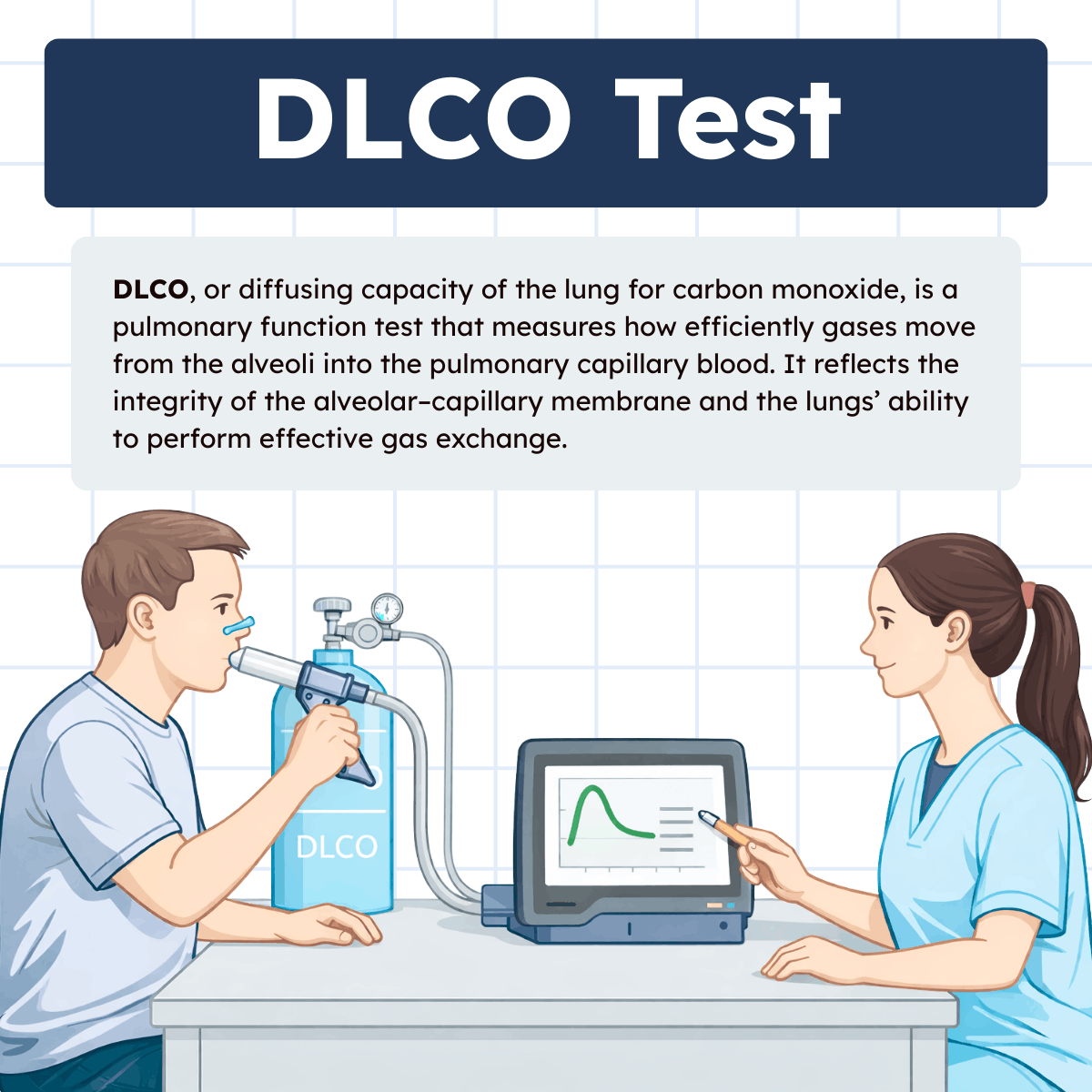
The diffusing capacity of the lung for carbon monoxide (DLCO) is a pulmonary function test that provides critical insight into how efficiently gases move from the air in the lungs into the bloodstream.
While spirometry measures airflow and lung volumes assess how much air the lungs can hold, DLCO focuses on gas exchange at the alveolar–capillary membrane.
For respiratory therapists and other healthcare professionals, understanding DLCO is essential for evaluating lung function, identifying underlying disease processes, and guiding clinical decision-making in both outpatient and acute care settings.

What Is DLCO?
DLCO stands for diffusing capacity of the lung for carbon monoxide. It measures how well gases pass from the alveoli into the pulmonary capillary blood. Carbon monoxide (CO) is used for this test because it binds very strongly to hemoglobin and is normally present in the blood at extremely low levels. This makes it an ideal gas for assessing diffusion without significantly altering blood oxygen levels.
During the test, the patient inhales a very small, harmless concentration of carbon monoxide mixed with an inert tracer gas (such as helium or methane), holds their breath for about 10 seconds, and then exhales. The difference between the amount of carbon monoxide inhaled and the amount exhaled reflects how much gas crossed the alveolar–capillary membrane into the bloodstream.
In simple terms, DLCO answers an important question: How effectively can the lungs transfer gas into the blood?
The Physiology Behind DLCO
Gas exchange occurs across the alveolar–capillary membrane, a thin barrier made up of alveolar epithelium, interstitial tissue, capillary endothelium, and plasma. Several factors influence how efficiently gases diffuse across this membrane, and DLCO is affected by all of them.
Key physiological determinants of DLCO include:
- Surface area available for gas exchange
Healthy lungs have millions of alveoli, creating a large surface area. Diseases that destroy alveoli reduce this surface area and lower DLCO. - Thickness of the alveolar–capillary membrane
Conditions that thicken this membrane make diffusion more difficult, decreasing DLCO. - Pulmonary capillary blood volume
Adequate blood flow is necessary to bind carbon monoxide to hemoglobin. Reduced perfusion lowers DLCO. - Hemoglobin concentration
Since carbon monoxide binds to hemoglobin, anemia can reduce DLCO, while polycythemia can increase it.
Note: Understanding these physiological principles helps respiratory therapists interpret DLCO results within the broader clinical picture.
How DLCO Is Measured
DLCO is most commonly measured using the single-breath technique, which is part of comprehensive pulmonary function testing.
The basic steps include:
- The patient exhales fully to residual volume.
- The patient inhales a test gas mixture rapidly to total lung capacity.
- A breath-hold of approximately 10 seconds is maintained.
- The patient exhales, and an alveolar gas sample is collected for analysis.
The result is reported as a numerical value and often expressed as a percentage of the predicted normal value based on age, sex, height, and sometimes ethnicity.
Respiratory therapists play a key role in coaching patients through the maneuver, ensuring proper technique, and identifying factors that may invalidate the test, such as poor breath-hold time or inadequate inspiratory volume.
Normal and Abnormal DLCO Values
DLCO results are typically categorized as:
- Normal: ~80–120% of predicted
- Mildly reduced: ~60–79% of predicted
- Moderately reduced: ~40–59% of predicted
- Severely reduced: <40% of predicted
A reduced DLCO indicates impaired gas transfer, but it does not specify the exact cause. Interpretation always requires correlation with spirometry, lung volumes, imaging, and clinical findings. An isolated low DLCO can be especially significant and often prompts further investigation.
Clinical Conditions That Affect DLCO
DLCO is particularly valuable because it helps differentiate between various pulmonary and cardiovascular conditions.
Conditions Associated With a Decreased DLCO
- Emphysema: Destruction of alveolar walls reduces surface area for diffusion.
- Interstitial lung disease (ILD): Fibrosis thickens the alveolar–capillary membrane, impairing diffusion.
- Pulmonary vascular disease: Reduced pulmonary blood flow limits gas uptake.
- Pulmonary embolism: Ventilated but underperfused alveoli decrease effective diffusion.
- Anemia: Reduced hemoglobin decreases the blood’s capacity to bind carbon monoxide.
Conditions Associated With a Normal or Increased DLCO
- Asthma: DLCO is often normal or increased due to increased pulmonary blood volume during inflammation.
- Polycythemia: Increased hemoglobin levels enhance carbon monoxide binding.
- Pulmonary hemorrhage: Free hemoglobin in the alveoli can artificially elevate DLCO.
Note: Recognizing these patterns helps respiratory therapists contribute meaningfully to differential diagnosis and patient assessment.
Why DLCO Is Relevant to Respiratory Therapists
DLCO is highly relevant to respiratory therapists because it bridges physiology, pathology, and clinical application. Unlike spirometry, which primarily assesses airflow limitation, DLCO evaluates the effectiveness of gas exchange, a central function of the lungs.
Respiratory therapists are often responsible for:
- Performing DLCO testing accurately and safely
- Ensuring patient understanding and cooperation
- Recognizing technical errors that may affect results
- Providing preliminary insights to providers based on testing patterns
Note: DLCO results frequently influence treatment decisions, disease monitoring, and referrals for further evaluation. In patients with unexplained dyspnea, DLCO can be one of the most revealing tests available.
DLCO in Disease Monitoring and Prognosis
Beyond diagnosis, DLCO is also valuable for tracking disease progression and response to therapy. In conditions such as interstitial lung disease or pulmonary hypertension, a declining DLCO over time may signal worsening disease, even when spirometry appears relatively stable.
DLCO is also used in:
- Preoperative evaluation for lung resection
- Assessment of disability or functional impairment
- Monitoring occupational or environmental lung disease
Note: Because it reflects the integrity of the alveolar–capillary unit, DLCO often correlates with exercise tolerance and oxygenation status, making it clinically meaningful beyond the test itself.
Factors That Can Affect DLCO Results
Several non-disease-related factors can influence DLCO measurements, and respiratory therapists must account for these during testing and interpretation.
Common influencing factors include:
- Smoking prior to testing (elevates baseline CO levels)
- Recent exercise (can transiently increase DLCO)
- Poor inspiratory effort or breath-hold technique
- Body position (supine DLCO may be higher than upright)
Note: Accurate patient preparation and careful test execution are essential to obtaining reliable results.
DLCO Compared to Other Pulmonary Function Tests
DLCO complements, rather than replaces, other pulmonary function tests. Spirometry evaluates airflow, lung volumes assess restriction or hyperinflation, and DLCO evaluates gas exchange.
For example:
- Obstructive disease with low DLCO often suggests emphysema
- Restrictive disease with low DLCO points toward interstitial lung disease
- Normal spirometry with low DLCO raises concern for pulmonary vascular disease
Note: This integrative approach makes DLCO a powerful tool in comprehensive respiratory assessment.
DLCO Practice Questions
1. What is diffusion?
The flow of particles from an area of higher concentration to an area of lower concentration.
2. What does the diffusing capacity test provide info about?
The transfer of gas between the alveoli and the pulmonary capillary blood.
3. What three general techniques can be performed in the DLCO measurement?
Steady state, rebreathing, and single breath.
4. What is the most common DLCO technique?
Single breath technique
5. What are the indications for DLCO testing?
(1) Evaluate or follow the progress of parenchymal lung disease, (2) evaluate pulmonary involvement in systemic diseases, (3) determine progression and differentiate between different types of obstructive lung disease, (4) evaluate cardiovascular diseases, (5) quantify disability associated with interstitial lung disease, and (6) evaluate pulmonary hemorrhage or polycythemia.
6. What does DLCO measure?
The transfer of CO across the alveolar-capillary membrane, which shows small differences between inspired and expired CO gas. It also measures how much CO crosses the membrane.
7. What is DLCO measured in conjunction with?
Spirometry and lung volumes
8. What units is DLCO measured in?
mL/min/mmHg
9. What does CO combine with, and how many times is it more readily available than O2?
It combines with Hb and is 210 times more readily available than O2.
10. What is the primary limiting factor to the diffusion of CO if the hemoglobin and ventilatory function are normal?
The status of the alveolar-capillary membrane.
11. What is DLCO directly related to?
Alveolar lung volume
12. What does the DLCO gas mixture consist of?
0.3% CO, 0.3% inert gas (He, Methane, or Neon), 21% Oxygen, and balance nitrogen.
13. The two major gases involved in lung diffusion must move through what two barriers?
The alveolar-capillary (A-C) membrane, and the blood plasma-red blood cell barrier.
14. The rate of diffusion across the primary liquid barriers is limited by what?
The surface area for diffusion, the distance the gas molecules must travel, the solubility coefficient of the gases in a liquid, the partial pressure difference between air and blood for each gas, and the density of each gas.
15. Why is CO more suitable for measuring diffusing capacity than other gases?
It has a great affinity for Hb, it’s soluble in blood, and its concentration in venous blood is insignificant.
16. The measurement of DLCO involves what?
The rate of consumption (uptake) of CO by the blood from the alveoli.
17. Diffusion across the A-C membrane depends on what?
The difference between the gas tension (or partial pressure) in the alveolus and in the plasma, the surface area available for diffusion, the distance the gas molecules must travel, and tissue characteristics.
18. What conditions can lower the DLCO value?
Respiratory muscle weakness, deformity preventing maximal inflation, reduced Hb, pulmonary embolus, increased CO or inspired O2 concentration, lung resection, emphysema, and interstitial lung disease.
19. What conditions can increase the DLCO value?
Increased Hb (polycythemia), decreased intrathoracic pressure, exercise, asthma, and the supine position.
20. What causes increased DLCO values?
Increased pulmonary capillary blood volume, exercise, left-to-right intracardiac shunts, left heart failure, supine position, polycythemia, and asthma.
21. What causes decreased DLCO values?
Small lung volume (e.g., lung resection), pulmonary fibrosis, emphysema, pulmonary vascular and cardiovascular diseases, anemia, renal failure, and marijuana and/or cigarette smoking.
22. How many times should the single breath-hold technique be repeated?
Twice
23. How long should the delay be between repeated maneuvers for the single breath-hold technique?
4-5 minutes
24. How long should the breath-hold time be within for a single breath-hold maneuver?
8-12 seconds
25. What are the acceptable criteria for exhalation during DLCO single breath-hold technique?
It should be rapid but not forced and 4 seconds or less.
26. How long should the interval be between repeated DLCO single-breath maneuvers?
4 minutes
27. How does poor inspiratory effort affect the DLCO results?
If it’s less than 85% of VC, it will decrease the DLCO.
28. What technique should you use if the patient can’t hold their breath?
Rebreathing technique
29. What factors affect the DLCO?
Restrictive lung disease, obstructive lung disease, inhalation of toxic gas or organic agents, increased HR, CHR, pulmonary hypertension, radiation therapy, COHb, decreased or increased Hb and hematocrit, altitude above sea level, body position, and obesity.
30. How do restrictive lung diseases affect the DLCO?
They cause low DLCO results because of decreased diffusion.
31. How does the inhalation of toxic or organic agents affect the DLCO?
Causes decreased results
32. How does an increased HR affect the DLCO?
Causes increased results
33. How do CHF and pulmonary edema affect the DLCO?
They cause increased results.
34. How does pulmonary hypertension affect the DLCO?
Causes increased results
35. How does radiation therapy affect the DLCO?
Causes decreased results
36. How does COHb affect the DLCO?
Causes decreased results
37. How does a decreased Hb and hematocrit affect the DLCO?
They cause decreased results
38. How does an increased Hb and hematocrit affect the DLCO?
They cause increased results.
39. How does altitude above sea level affect the DLCO?
Causes increased results
40. How does the patient’s body position affect the DLCO?
Laying down causes increased results
41. How does obesity affect the DLCO?
Causes increased results
42. What changes as you increase altitude?
The PaO2 decreases.
43. What does DLCO measure?
It measures the extent to which oxygen passes from the alveoli into the blood.
44. What is the total amount of blood in the pulmonary capillaries?
60-140 mL
45. Fick’s law for diffusion is proportional to what?
Pressure gradient and surface area
46. Fick’s law for diffusion is inversely proportional to what?
Thickness
47. What will an obstructive spirometry test show?
Low FEV1/FVC ratio
48. What does it mean if the DLCO and FEV1/FVC ratio are both low?
It could mean COPD or emphysema.
49. What does it mean if the DLCO is normal or high and the FEV1/FVC ratio is low?
It could mean asthma.
50. What are the normal values for FEV1, TLC, and DLCO?
80-120% of predicted
51. If spirometry tests are normal, but the DLCO is low, what is this indicative of?
ILD, anemia, or pulmonary vascular disease
52. If a spirometry test indicates a restrictive lung disease and the DLCO is low, what does this mean?
It could mean that the patient has an interstitial lung disease.
53. What diseases can cause a decreased DLCO?
Restrictive patterns, inhalation of toxic gases, radiation therapy, lung tumors, emphysema, chronic bronchitis, and asthma.
54. What is DLCO directly affected by?
Hemoglobin, carboxyhemoglobin, alveolar PCO2, pulmonary capillary blood volume, high altitude, and poor inspiratory effort.
55. How does hemoglobin affect the DLCO?
Low Hb means a decreased DLCO and high Hb means an increased DLCO.
56. How does having carboxyhemoglobin affect the DLCO?
COHb decreases the DLCO
57. How does having an increased PaCO2 affect the DLCO?
An increased PaCO2 increases the DLCO due to hypoventilation.
58. How does having an increased pulmonary capillary blood volume affect the DLCO?
Increased blood volume increases the DLCO.
59. How does a high altitude affect the DLCO?
A high altitude increases the DLCO because there is less oxygen.
60. Is DLCO the same as diffusion capacity?
Yes, DLCO is often referred to as the diffusion capacity for carbon monoxide in the lungs.
61. Why is carbon monoxide used instead of oxygen to measure diffusing capacity?
Because CO is diffusion-limited and binds strongly to hemoglobin, making transfer across the alveolar-capillary membrane easier to quantify.
62. What does a reduced DLCO with normal spirometry most strongly suggest?
Pulmonary vascular disease or anemia.
63. How does emphysema specifically reduce DLCO?
By destroying alveolar walls and reducing the surface area available for gas exchange.
64. Why is DLCO often preserved or elevated in asthma?
Because alveolar surface area is maintained and pulmonary capillary blood volume may be increased.
65. What effect does smoking shortly before testing have on DLCO?
It lowers DLCO due to increased carboxyhemoglobin levels.
66. Why must hemoglobin levels be considered when interpreting DLCO results?
Because DLCO is directly dependent on the amount of hemoglobin available to bind carbon monoxide.
67. What correction is often applied to DLCO values in anemic patients?
Adjustment based on measured hemoglobin concentration.
68. How does pulmonary embolism affect DLCO?
It decreases DLCO by reducing pulmonary capillary blood flow.
69. Why does DLCO increase during exercise?
Because pulmonary capillary recruitment and distension increase gas exchange surface area.
70. What does a normal DLCO indicate about the alveolar-capillary membrane?
That gas transfer across the membrane is intact.
71. How does interstitial lung disease reduce DLCO?
By thickening the alveolar-capillary membrane and increasing diffusion distance.
72. What DLCO pattern is typically seen in pulmonary fibrosis?
Markedly reduced DLCO.
73. Why is DLCO considered a sensitive test for early interstitial lung disease?
Because diffusion impairment occurs before spirometry abnormalities appear.
74. What happens to DLCO in pulmonary hemorrhage?
It increases due to the presence of hemoglobin within the alveoli.
75. How does body position influence DLCO measurements?
Supine positioning increases DLCO by increasing pulmonary blood volume.
76. Why must patients avoid supplemental oxygen before DLCO testing?
High oxygen concentrations compete with CO for hemoglobin binding and lower DLCO results.
77. What does DLCO reflect more accurately than spirometry in pulmonary vascular disease?
Pulmonary capillary blood flow and gas exchange efficiency.
78. How does lung resection affect DLCO?
It decreases DLCO due to reduced alveolar surface area.
79. Why is DLCO measured after spirometry in pulmonary function testing?
Because spirometry helps interpret DLCO results in the context of airflow and lung volume patterns.
80. What does a low DLCO with normal lung volumes and airflow most likely indicate?
Pulmonary vascular disease or early interstitial lung involvement.
81. Why is DLCO reduced in patients with pulmonary hypertension?
Because elevated pulmonary vascular resistance reduces pulmonary capillary blood volume available for gas exchange.
82. How does left heart failure affect DLCO?
It often increases DLCO due to pulmonary capillary engorgement and increased blood volume.
83. What DLCO finding is commonly seen in chronic bronchitis?
DLCO is usually normal because alveolar surface area is preserved.
84. Why should DLCO results be corrected for altitude?
Higher altitude lowers alveolar oxygen tension, which artificially increases DLCO values if not corrected.
85. How does poor breath-hold technique affect DLCO results?
It falsely lowers DLCO due to inadequate gas equilibration.
86. Why is a stable breath-hold critical during single-breath DLCO testing?
To allow accurate diffusion of carbon monoxide across the alveolar-capillary membrane.
87. What DLCO pattern is expected in pulmonary edema?
DLCO may be increased due to increased pulmonary capillary blood volume.
88. How does lung consolidation affect DLCO?
It decreases DLCO by limiting ventilated alveolar surface area.
89. Why is DLCO helpful in distinguishing emphysema from asthma?
Emphysema lowers DLCO, while asthma typically has a normal or elevated DLCO.
90. What does a declining DLCO over time indicate in chronic lung disease?
Progressive loss of alveolar-capillary surface area or worsening pulmonary vascular disease.
91. Why is DLCO considered effort-dependent?
Because inadequate inspiration or breath-hold reduces alveolar volume and gas diffusion.
92. What role does alveolar volume (VA) play in DLCO interpretation?
DLCO is directly proportional to alveolar volume; smaller VA lowers DLCO.
93. How does pregnancy affect DLCO?
DLCO may increase due to expanded blood volume and increased pulmonary capillary flow.
94. Why is DLCO often reduced after lung transplantation?
Because of reduced alveolar surface area and altered pulmonary capillary circulation.
95. What DLCO finding is typical in sarcoidosis?
DLCO is often reduced due to interstitial involvement and fibrosis.
96. How does pulmonary capillary recruitment influence DLCO?
Increased recruitment raises DLCO by expanding the gas exchange surface.
97. Why is DLCO decreased in anemia even if lung structure is normal?
Because reduced hemoglobin limits carbon monoxide uptake.
98. What DLCO change is expected with acute alveolar inflammation?
DLCO is usually decreased due to thickened diffusion barriers.
99. Why must DLCO be interpreted alongside lung volumes?
Because low lung volumes alone can reduce DLCO independent of membrane pathology.
100. What clinical condition causes an isolated increase in DLCO with otherwise normal PFTs?
Pulmonary hemorrhage
Final Thoughts
The diffusing capacity of the lung for carbon monoxide (DLCO) is a vital component of pulmonary function testing that provides unique insight into the lungs’ ability to transfer gas from air to blood. For respiratory therapists, understanding DLCO means understanding the core purpose of the respiratory system: effective gas exchange.
By mastering the principles behind DLCO measurement and interpretation, respiratory therapists can better identify disease patterns, support accurate diagnoses, and contribute to high-quality patient care. When combined with other pulmonary function tests and clinical findings, DLCO remains an indispensable tool in modern respiratory care.

Written by:
John Landry is a registered respiratory therapist from Memphis, TN, and has a bachelor's degree in kinesiology. He enjoys using evidence-based research to help others breathe easier and live a healthier life.
References
- Goldin J, Cascella M. Diffusing Capacity of the Lungs for Carbon Monoxide. [Updated 2024 Oct 6]. In: StatPearls [Internet]. Treasure Island (FL): StatPearls Publishing; 2025.