
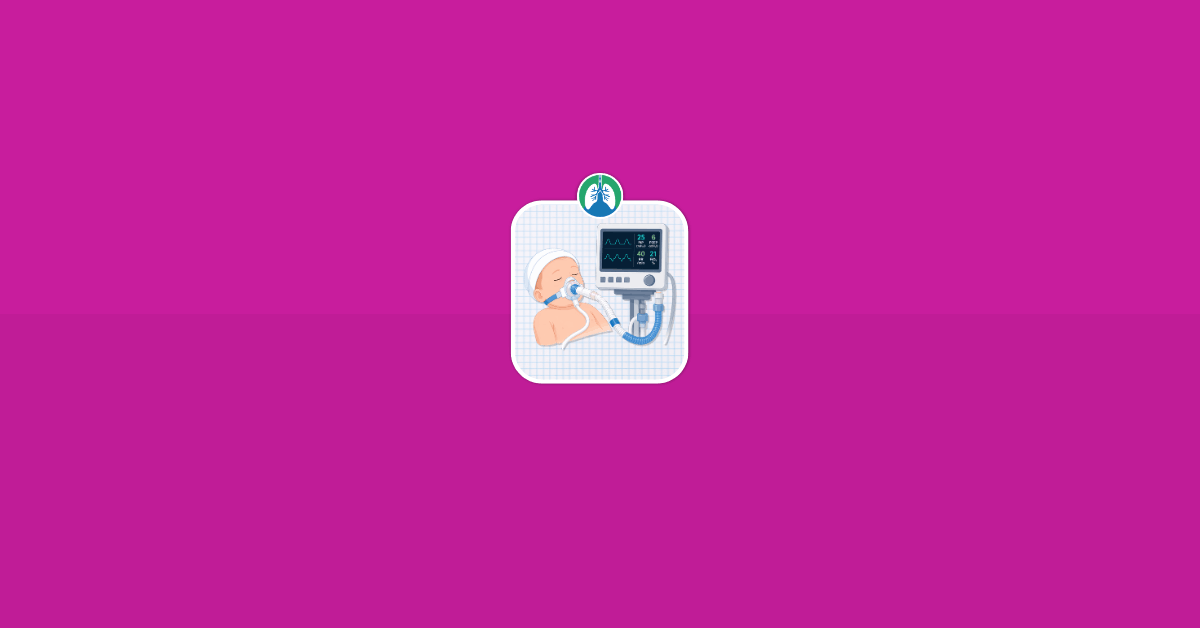
Neonatal mechanical ventilation is a specialized form of respiratory support used to assist or replace spontaneous breathing in newborns who cannot maintain adequate gas exchange. It is most commonly required in premature infants or those with significant respiratory disease.
Because neonatal lungs are structurally immature and highly susceptible to injury, ventilatory support must be applied with precision and careful monitoring.
The primary objective is to ensure adequate oxygenation and ventilation while minimizing complications. A thorough understanding of neonatal physiology, ventilator modes, and clinical decision-making is essential for safe and effective management.

Overview of Neonatal Respiratory Physiology
Neonates differ significantly from older children and adults in terms of respiratory structure and function. These differences directly influence how mechanical ventilation is applied.
The neonatal chest wall is highly compliant, meaning it offers little resistance to inward collapse during inspiration. At the same time, lung compliance may be reduced, especially in premature infants with surfactant deficiency. This imbalance increases the risk of alveolar collapse and reduced functional residual capacity (FRC).
Airways in neonates are small in diameter, which increases resistance to airflow. Even minimal swelling or obstruction can significantly impair ventilation. In addition, the number of alveoli is lower at birth, limiting the available surface area for gas exchange.
Another important consideration is the immaturity of the respiratory control center in the brain. This can lead to irregular breathing patterns and episodes of apnea, particularly in premature infants.
These physiological characteristics explain why neonates are prone to atelectasis, hypoxemia, and respiratory fatigue. Mechanical ventilation must be tailored to support these vulnerable systems without causing further harm.

Indications for Neonatal Mechanical Ventilation
Mechanical ventilation is initiated when a neonate is unable to maintain adequate oxygenation or ventilation through spontaneous breathing or noninvasive support.
Common indications include:
- Persistent hypoxemia despite supplemental oxygen
- Hypercapnia with respiratory acidosis
- Recurrent apnea, especially when associated with bradycardia
- Increased work of breathing leading to fatigue
- Inability to protect the airway
- Severe respiratory disease
Several clinical conditions frequently require ventilatory support. Respiratory distress syndrome is one of the most common causes, particularly in premature infants who lack sufficient surfactant. Other conditions include meconium aspiration syndrome, pneumonia, sepsis, persistent pulmonary hypertension of the newborn, and congenital diaphragmatic hernia.
In clinical practice, the decision to initiate mechanical ventilation is based on a combination of physical examination findings, blood gas analysis, and the infant’s overall stability.
Noninvasive Respiratory Support
Before initiating invasive mechanical ventilation, noninvasive methods are often used when appropriate. These strategies aim to improve gas exchange while avoiding the risks associated with intubation.
Nasal Continuous Positive Airway Pressure (CPAP)
CPAP is one of the most commonly used forms of noninvasive support in neonates. It delivers continuous positive pressure throughout the respiratory cycle, helping to keep alveoli open and maintain functional residual capacity.
CPAP is particularly effective in:
- Mild to moderate respiratory distress
- Prevention of alveolar collapse
- Post-extubation support
Note: By stabilizing the airways and improving oxygenation, CPAP can reduce the need for invasive ventilation.
Noninvasive Positive Pressure Ventilation (NPPV)
NPPV provides additional ventilatory support by delivering intermittent positive pressure breaths through a nasal interface. It is often used in infants with apnea of prematurity or those who require more support than CPAP alone can provide.
Despite its benefits, noninvasive ventilation is not suitable for all patients. Infants with severe respiratory failure, hemodynamic instability, or an inability to protect the airway require invasive mechanical ventilation.
Intubation and Airway Management
When noninvasive methods are insufficient, endotracheal intubation is performed to establish a secure airway and allow for mechanical ventilation.
Indications for Intubation
Intubation is indicated in neonates with:
- Severe respiratory distress
- Persistent apnea
- Hypoxemia unresponsive to oxygen therapy
- Respiratory acidosis
- Need for surfactant administration
- Cardiopulmonary resuscitation
Equipment and Technique
Neonatal intubation requires specialized equipment due to the small size of the airway. Endotracheal tubes are selected based on the infant’s weight and gestational age. Laryngoscope blades are also smaller and designed for neonatal anatomy.
Proper technique is essential to minimize complications. Visualization of the vocal cords, careful insertion of the tube, and confirmation of placement are critical steps. Tube placement is typically confirmed using auscultation, chest movement, carbon dioxide detection, and chest radiography.
Complications of Intubation
Intubation carries several risks, including:
- Airway trauma
- Esophageal intubation
- Hypoxia during the procedure
- Bradycardia
- Infection
Note: Because of these risks, intubation should be performed by trained personnel with appropriate preparation and monitoring.
Basic Principles of Mechanical Ventilation
Mechanical ventilation in neonates is based on delivering controlled breaths to support gas exchange while minimizing lung injury.
Pressure-Controlled Ventilation
Pressure-controlled ventilation is commonly used in neonates. In this mode, the ventilator delivers breaths to a preset peak inspiratory pressure. The tidal volume varies depending on lung compliance and resistance.
This approach helps limit excessive airway pressure, reducing the risk of barotrauma. However, changes in lung compliance can result in variable tidal volumes, which must be monitored closely.
Volume-Targeted Ventilation
Volume-targeted ventilation aims to deliver a consistent tidal volume with each breath. This approach reduces the risk of volutrauma by avoiding excessive lung expansion.
Modern ventilators can combine pressure and volume targeting, adjusting pressure as needed to achieve the desired tidal volume. This method is increasingly preferred due to its ability to provide stable ventilation while protecting the lungs.
Key Ventilator Parameters
Several key parameters are adjusted during neonatal ventilation:
- Peak Inspiratory Pressure (PIP): Determines the level of lung inflation
- Positive End-Expiratory Pressure (PEEP): Maintains alveolar stability
- Respiratory Rate: Typically higher than in adults
- Inspiratory Time: Short due to rapid respiratory cycles
- Fraction of Inspired Oxygen (FiO₂): Adjusted to maintain target oxygen saturation
Note: These settings must be individualized based on the infant’s condition and response to therapy.
Mechanisms of Gas Exchange
Understanding how gas exchange occurs during mechanical ventilation is essential for optimizing settings.
Conventional Ventilation
In conventional ventilation, gas exchange occurs through bulk flow. Air moves in and out of the lungs, allowing oxygen to enter the bloodstream and carbon dioxide to be removed.
High-Frequency Ventilation
In high-frequency ventilation, gas exchange occurs through several alternative mechanisms:
- Molecular diffusion
- Pendelluft, which involves gas movement between lung regions
- Asymmetric velocity profiles
Note: These mechanisms allow effective gas exchange even with very small tidal volumes, reducing the risk of lung injury.
Ventilator Settings and Adjustments
Ventilator adjustments are guided by blood gas analysis and clinical assessment.
Improving Ventilation
To enhance carbon dioxide removal:
- Increase respiratory rate
- Increase tidal volume or inspiratory pressure
- Adjust inspiratory time
- Reduce dead space
Improving Oxygenation
To improve oxygen levels:
- Increase FiO₂
- Increase PEEP
- Increase mean airway pressure
- Adjust inspiratory time
- Optimize lung recruitment
Note: All adjustments must be made cautiously to avoid complications such as overdistention or impaired cardiac output.
Patient–Ventilator Synchrony
Effective interaction between the patient and the ventilator is essential for successful ventilation.
Poor synchrony can lead to increased work of breathing, air trapping, and hemodynamic instability. Modern ventilators use sensitive triggering mechanisms to detect the infant’s respiratory effort and deliver synchronized breaths.
Modes such as synchronized intermittent mandatory ventilation and pressure support ventilation improve synchrony by aligning ventilator breaths with the infant’s natural breathing pattern.
Monitoring During Mechanical Ventilation
Continuous monitoring is essential to ensure safe and effective ventilation in neonates. Because their condition can change rapidly, close observation allows for timely adjustments and early detection of complications.
Clinical Assessment
Bedside assessment remains a critical component of monitoring. Clinicians evaluate:
- Chest rise and symmetry
- Breath sounds
- Respiratory effort
- Skin color and perfusion
- Level of activity and responsiveness
Note: These findings provide immediate feedback on the effectiveness of ventilation.
Oxygenation Monitoring
Pulse oximetry is used continuously to monitor oxygen saturation. Target ranges are carefully maintained to avoid both hypoxemia and excessive oxygen exposure. Maintaining appropriate oxygen levels is particularly important in neonates due to the risk of complications such as retinopathy of prematurity.
Blood Gas Analysis
Arterial or capillary blood gas measurements provide detailed information about ventilation and acid-base status. Key values include:
- pH
- Partial pressure of oxygen (PaO₂)
- Partial pressure of carbon dioxide (PaCO₂)
Note: These measurements guide adjustments in ventilator settings.
Ventilator Parameters
Modern ventilators display real-time data such as:
- Airway pressures
- Tidal volumes
- Leak measurements
- Flow patterns
Note: Monitoring these parameters helps ensure that the delivered ventilation matches the intended settings.
Imaging and Additional Monitoring
Chest radiographs are used to confirm endotracheal tube placement and evaluate lung expansion. Hemodynamic monitoring, including blood pressure and heart rate, is also important because ventilation can affect cardiovascular function.
High-Frequency Ventilation
High-frequency ventilation is an advanced mode used when conventional ventilation is insufficient or when lung-protective strategies are required.
High-Frequency Oscillatory Ventilation (HFOV)
HFOV delivers very small tidal volumes at extremely high frequencies while maintaining a constant mean airway pressure. This approach helps keep alveoli open and reduces the risk of lung injury.
HFOV is commonly used in:
- Severe respiratory distress syndrome
- Persistent hypoxemia
- Diffuse lung disease
Note: Oxygenation is primarily controlled by mean airway pressure, while carbon dioxide removal is influenced by frequency and amplitude.
High-Frequency Jet Ventilation (HFJV)
HFJV delivers rapid pulses of gas directly into the airway, with passive exhalation. It is particularly useful in cases involving air leak syndromes, as it minimizes pressure fluctuations.
Both HFOV and HFJV require specialized equipment and expertise, and they are typically used in intensive care settings.
Surfactant Replacement Therapy
Surfactant therapy plays a critical role in the management of neonatal respiratory distress syndrome.
Surfactant is a substance that reduces surface tension within the alveoli, preventing collapse during exhalation. Premature infants often have insufficient surfactant, leading to poor lung compliance and impaired gas exchange.
Administration
Surfactant is administered through the endotracheal tube. The dose and type of surfactant depend on the specific preparation being used.
Clinical Benefits
Surfactant therapy results in:
- Improved oxygenation
- Increased lung compliance
- Reduced ventilator pressures
- Lower risk of complications
Note: Early administration is associated with better outcomes.
Extracorporeal Membrane Oxygenation (ECMO)
Extracorporeal membrane oxygenation is a life support technique used in severe cases of neonatal respiratory failure when conventional therapies are ineffective.
Indications
ECMO may be considered in:
- Severe hypoxemia unresponsive to ventilation
- Persistent pulmonary hypertension
- Meconium aspiration syndrome
- Certain congenital conditions
Mechanism
Blood is removed from the body, passed through an artificial lung where gas exchange occurs, and then returned to the circulation. This allows the lungs to rest and recover.
Risks
ECMO carries significant risks, including bleeding, infection, and complications related to anticoagulation. It is reserved for critically ill patients in specialized centers.
Complications of Mechanical Ventilation
Mechanical ventilation can lead to several complications, particularly in fragile neonatal lungs.
Lung Injury
- Barotrauma occurs from excessive airway pressure
- Volutrauma results from overdistention of the lungs
- Atelectrauma is caused by repeated collapse and reopening of alveoli
Note: These forms of injury can contribute to long-term lung disease.
Oxygen Toxicity
High concentrations of oxygen can damage lung tissue and increase the risk of retinopathy of prematurity. Careful titration of oxygen is essential.
Air Leak Syndromes
Air may escape from the lungs into surrounding spaces, leading to conditions such as pneumothorax or pneumomediastinum. These complications can be life-threatening and require prompt management.
Cardiovascular Effects
Positive pressure ventilation can reduce venous return to the heart, leading to decreased cardiac output and hypotension. This highlights the importance of balancing ventilatory support with hemodynamic stability.
Infection
Prolonged intubation increases the risk of infection, including ventilator-associated pneumonia. Strict infection control practices are necessary to minimize this risk.
Lung-Protective Strategies
Preventing lung injury is a primary focus in neonatal ventilation. Several strategies are used to reduce harm while maintaining adequate gas exchange.
- Low Tidal Volume Ventilation: Using small tidal volumes reduces the risk of overdistention and volutrauma.
- Appropriate PEEP: Adequate PEEP helps maintain alveolar stability and prevents collapse at the end of exhalation.
- Limiting Oxygen Exposure: FiO₂ is kept at the lowest level that maintains acceptable oxygenation to reduce the risk of oxygen toxicity.
- Permissive Hypercapnia: Allowing slightly elevated carbon dioxide levels can reduce the need for high ventilator pressures, provided that the pH remains within an acceptable range.
- Early Use of Noninvasive Support: Whenever possible, transitioning to noninvasive ventilation reduces the duration of intubation and associated complications.
Weaning from Mechanical Ventilation
Weaning is the process of gradually reducing ventilatory support as the infant’s condition improves.
Criteria for Weaning
Before initiating weaning, the following conditions should be met:
- Stable blood gas values
- Improved oxygenation with lower FiO₂
- Adequate spontaneous breathing effort
- Reduced ventilator requirements
Weaning Process
Ventilator support is reduced gradually by adjusting:
- Respiratory rate
- Inspiratory pressure or tidal volume
- FiO₂
Note: Close monitoring is necessary to ensure that the infant tolerates these changes.
Extubation
Extubation is considered when the infant can maintain adequate ventilation and oxygenation without invasive support. After extubation, noninvasive methods such as CPAP or NIPPV are often used to provide ongoing support.
Special Considerations in Neonates
Neonates require individualized care due to their unique physiological characteristics. Their highly compliant chest wall and low functional residual capacity increase the risk of alveolar collapse. Surfactant deficiency in premature infants further contributes to instability.
In addition, immature respiratory control can lead to apnea, requiring careful monitoring and support. These factors make neonatal ventilation more complex and highlight the importance of precise adjustments and continuous assessment.
Neonatal Mechanical Ventilation Practice Questions
1. What is neonatal mechanical ventilation?
The use of a machine to assist or control breathing in newborns who cannot maintain adequate gas exchange.
2. When is mechanical ventilation indicated in neonates?
When a newborn cannot maintain adequate oxygenation or ventilation with spontaneous breathing or noninvasive support.
3. What is hypoxemia?
A condition where there is a low level of oxygen in the blood.
4. What is hypercapnia?
An elevated level of carbon dioxide in the blood.
5. What is apnea in neonates?
A temporary cessation of breathing, commonly seen in premature infants.
6. What is the difference between low-frequency and high-frequency ventilation?
Low-frequency ventilation delivers ≤150 breaths per minute, while high-frequency ventilation delivers >150 breaths per minute.
7. What is CPAP used for in neonates?
To maintain alveolar stability and improve oxygenation without invasive ventilation.
8. What is the primary goal of neonatal mechanical ventilation?
To maintain adequate oxygenation and ventilation while minimizing lung injury.
9. What is peak inspiratory pressure (PIP)?
The maximum pressure applied during inspiration to inflate the lungs.
10. What is positive end-expiratory pressure (PEEP)?
The pressure maintained in the lungs at the end of exhalation to prevent alveolar collapse.
11. What ventilator adjustment improves oxygenation?
Increasing FiO₂ or PEEP.
12. What ventilator adjustment improves CO₂ removal?
Increasing respiratory rate or tidal volume.
13. What is assist-control (A/C) ventilation?
A mode that delivers breaths in response to patient effort or at a set rate.
14. What is synchronized intermittent mandatory ventilation (SIMV)?
A mode that delivers mandatory breaths synchronized with the patient’s effort.
15. What is pressure-controlled ventilation?
A mode that delivers breaths using a set inspiratory pressure.
16. What is volume-targeted ventilation?
A mode that delivers a consistent tidal volume with each breath.
17. Why is volume-targeted ventilation beneficial?
It helps reduce the risk of volutrauma by avoiding excessive lung expansion.
18. What is high-frequency oscillatory ventilation (HFOV)?
A ventilation mode that uses very small tidal volumes at very high frequencies.
19. What is high-frequency jet ventilation (HFJV)?
A mode that delivers rapid bursts of gas with passive exhalation.
20. What is molecular diffusion in ventilation?
The movement of gas molecules from an area of high concentration to low concentration.
21. What is pendelluft?
The movement of gas between different regions of the lungs.
22. What is FiO₂?
The fraction of inspired oxygen delivered to the patient.
23. What monitoring tool is used to assess oxygen saturation?
Pulse oximetry
24. What is measured in arterial blood gas analysis?
pH, PaO₂, and PaCO₂
25. What is the role of chest radiographs in ventilated neonates?
To assess lung expansion and confirm endotracheal tube placement.
26. What is the purpose of inspiratory time in neonatal ventilation?
It determines how long the lungs are inflated during each breath.
27. Why is inspiratory time shorter in neonates?
Because neonates have faster respiratory rates and shorter breathing cycles.
28. What is mean airway pressure?
The average pressure in the airways during the entire respiratory cycle.
29. How does increasing mean airway pressure affect oxygenation?
It improves oxygenation by enhancing alveolar recruitment.
30. What is dead space in ventilation?
The portion of the airway where gas exchange does not occur.
31. How can dead space be reduced in neonates?
By minimizing circuit length and avoiding unnecessary connectors.
32. What is patient–ventilator synchrony?
The coordination between the infant’s breathing efforts and ventilator-delivered breaths.
33. What happens when synchrony is poor?
It can increase work of breathing and lead to air trapping.
34. What is airway protection in neonates?
Maintaining a clear and secure airway to prevent aspiration or obstruction.
35. What is respiratory acidosis?
A condition where elevated CO₂ leads to a decrease in blood pH.
36. What is the significance of chest rise during ventilation?
It indicates effective lung inflation and adequate tidal volume delivery.
37. Why are neonates more prone to atelectasis?
Due to low functional residual capacity and surfactant deficiency.
38. What is surfactant?
A substance that reduces surface tension in the alveoli.
39. Why is surfactant important in neonates?
It prevents alveolar collapse and improves lung compliance.
40. What is respiratory distress syndrome (RDS)?
A condition caused by surfactant deficiency leading to poor lung expansion.
41. What is meconium aspiration syndrome (MAS)?
A condition where a newborn inhales meconium-stained fluid, causing airway obstruction.
42. What is persistent pulmonary hypertension of the newborn (PPHN)?
A condition where pulmonary blood flow remains restricted after birth.
43. What is pulmonary hemorrhage in neonates?
Bleeding into the lung tissue, which can impair gas exchange.
44. What is pneumonia in neonates?
An infection of the lungs that affects oxygenation and ventilation.
45. What is the purpose of adjusting respiratory rate on the ventilator?
To control carbon dioxide elimination.
46. What is the effect of increasing tidal volume?
It enhances ventilation but may increase the risk of lung injury.
47. What is the risk of excessive inspiratory pressure?
It can lead to barotrauma.
48. What is the function of ventilator triggers?
To detect patient effort and initiate a breath.
49. Why is minimizing ventilator pressure important?
To reduce the risk of lung injury.
50. What is the importance of individualized ventilator settings?
Each neonate has unique physiology and disease conditions requiring tailored support.
51. What is volutrauma?
Lung injury caused by excessive tidal volume leading to overdistention of alveoli.
52. What is barotrauma?
Lung injury caused by excessive airway pressure.
53. What is atelectrauma?
Lung injury caused by repeated collapse and reopening of alveoli.
54. What is oxygen toxicity?
Damage to lung tissue caused by prolonged exposure to high oxygen levels.
55. What is ventilator-associated lung injury (VALI)?
Lung injury resulting from the mechanical forces of ventilation.
56. What is an air leak syndrome?
A condition where air escapes from the lungs into surrounding spaces.
57. What is a pneumothorax?
Air accumulation in the pleural space that can collapse the lung.
58. What is pneumomediastinum?
Air present in the mediastinum surrounding the heart and great vessels.
59. How can mechanical ventilation affect cardiac output?
High intrathoracic pressure can reduce venous return and decrease cardiac output.
60. What is bronchopulmonary dysplasia (BPD)?
A chronic lung disease associated with prolonged ventilation and oxygen therapy.
61. Why are neonates at risk for infection during ventilation?
Due to prolonged intubation and immature immune systems.
62. What is ventilator-associated pneumonia (VAP)?
A lung infection that develops in patients receiving mechanical ventilation.
63. What is permissive hypercapnia?
A strategy that allows slightly elevated CO₂ levels to reduce ventilator-induced lung injury.
64. What is the goal of lung-protective ventilation?
To minimize lung injury while maintaining adequate gas exchange.
65. What is low tidal volume ventilation?
Using smaller tidal volumes to reduce the risk of overdistention.
66. Why is PEEP important in lung-protective strategies?
It prevents alveolar collapse at end expiration.
67. What is the risk of excessive PEEP?
It can impair venous return and reduce cardiac output.
68. Why should FiO₂ be minimized when possible?
To reduce the risk of oxygen toxicity and retinopathy of prematurity.
69. What is lung recruitment?
The process of opening collapsed alveoli to improve gas exchange.
70. What is nasal trauma in CPAP therapy?
Injury to the nasal tissues caused by prolonged use of nasal interfaces.
71. What is gastric distension during CPAP?
Air entering the stomach, which can cause discomfort and compromise ventilation.
72. What is humidification in ventilator circuits?
The addition of heat and moisture to inspired gases to protect the airway.
73. Why is humidification important in neonates?
To prevent airway drying and thick secretions.
74. What is the purpose of suctioning in ventilated neonates?
To remove secretions and maintain airway patency.
75. What is the recommended duration for suctioning?
Typically less than 10 to 15 seconds to minimize hypoxia.
76. What is extubation?
The removal of the endotracheal tube once the infant can breathe independently.
77. What is weaning from mechanical ventilation?
The gradual reduction of ventilatory support as the infant improves.
78. What indicates readiness for weaning?
Stable blood gases, low FiO₂ requirements, and adequate spontaneous breathing.
79. What is post-extubation support?
Noninvasive respiratory support provided after removing the endotracheal tube.
80. What is nasal intermittent mandatory ventilation (NIMV)?
A noninvasive mode that delivers intermittent positive pressure breaths through a nasal interface.
81. What is a high-flow nasal cannula?
A device that delivers heated, humidified oxygen at high flow rates.
82. What is apnea of prematurity?
A condition in which premature infants have episodes of stopped breathing due to immature respiratory control.
83. What is bradycardia in neonates?
A slower than normal heart rate, often associated with apnea.
84. What is cyanosis?
A bluish discoloration of the skin due to low oxygen levels.
85. What is tachypnea?
An abnormally rapid breathing rate.
86. What is nasal flaring?
Widening of the nostrils during breathing, indicating respiratory distress.
87. What are chest retractions ?
Inward movement of the chest wall during inspiration due to increased work of breathing.
88. What is grunting in neonates?
A sound made during exhalation to help maintain airway pressure and prevent alveolar collapse.
89. What is lung compliance?
The ability of the lungs to expand in response to pressure.
90. What is airway resistance?
The opposition to airflow within the respiratory tract.
91. Why do neonates have high airway resistance?
Because their airways are small and easily obstructed.
92. What is functional residual capacity (FRC)?
The volume of air remaining in the lungs at the end of normal exhalation.
93. Why is low FRC problematic in neonates?
It increases the risk of alveolar collapse and impaired gas exchange.
94. What is lung overdistention?
Excessive expansion of the lungs that can lead to injury.
95. What is the role of inspiratory pressure in ventilation?
It determines how much the lungs inflate during a breath.
96. What is amplitude in high-frequency ventilation?
The pressure variation that helps remove carbon dioxide.
97. How does frequency affect CO₂ removal in HFOV?
Lower frequency increases tidal volume and improves CO₂ elimination.
98. What is the purpose of mean airway pressure in HFOV?
To maintain lung volume and improve oxygenation.
99. What is an oxygen saturation target for neonates?
Typically between 92% and 96%, depending on clinical guidelines.
100. What is the overall goal of neonatal mechanical ventilation?
To support gas exchange while minimizing lung injury and promoting recovery.
Final Thoughts
Neonatal mechanical ventilation is a complex and carefully balanced intervention designed to support newborns with respiratory failure. Effective management requires a detailed understanding of neonatal physiology, ventilator modes, and the principles of lung protection.
Continuous monitoring, timely adjustments, and appropriate use of advanced therapies all contribute to improved outcomes.
While mechanical ventilation can be life-saving, it also carries risks that must be minimized through thoughtful clinical practice. Individualized care, guided by the infant’s condition and response to treatment, remains the foundation of successful neonatal respiratory support.

Written by:
John Landry is a registered respiratory therapist from Memphis, TN, and has a bachelor's degree in kinesiology. He enjoys using evidence-based research to help others breathe easier and live a healthier life.
References
- Chakkarapani AA, Adappa R, Mohammad Ali SK, Gupta S, Soni NB, Chicoine L, Hummler HD. “Current concepts of mechanical ventilation in neonates” – Part 1: Basics. Int J Pediatr Adolesc Med. 2020.