

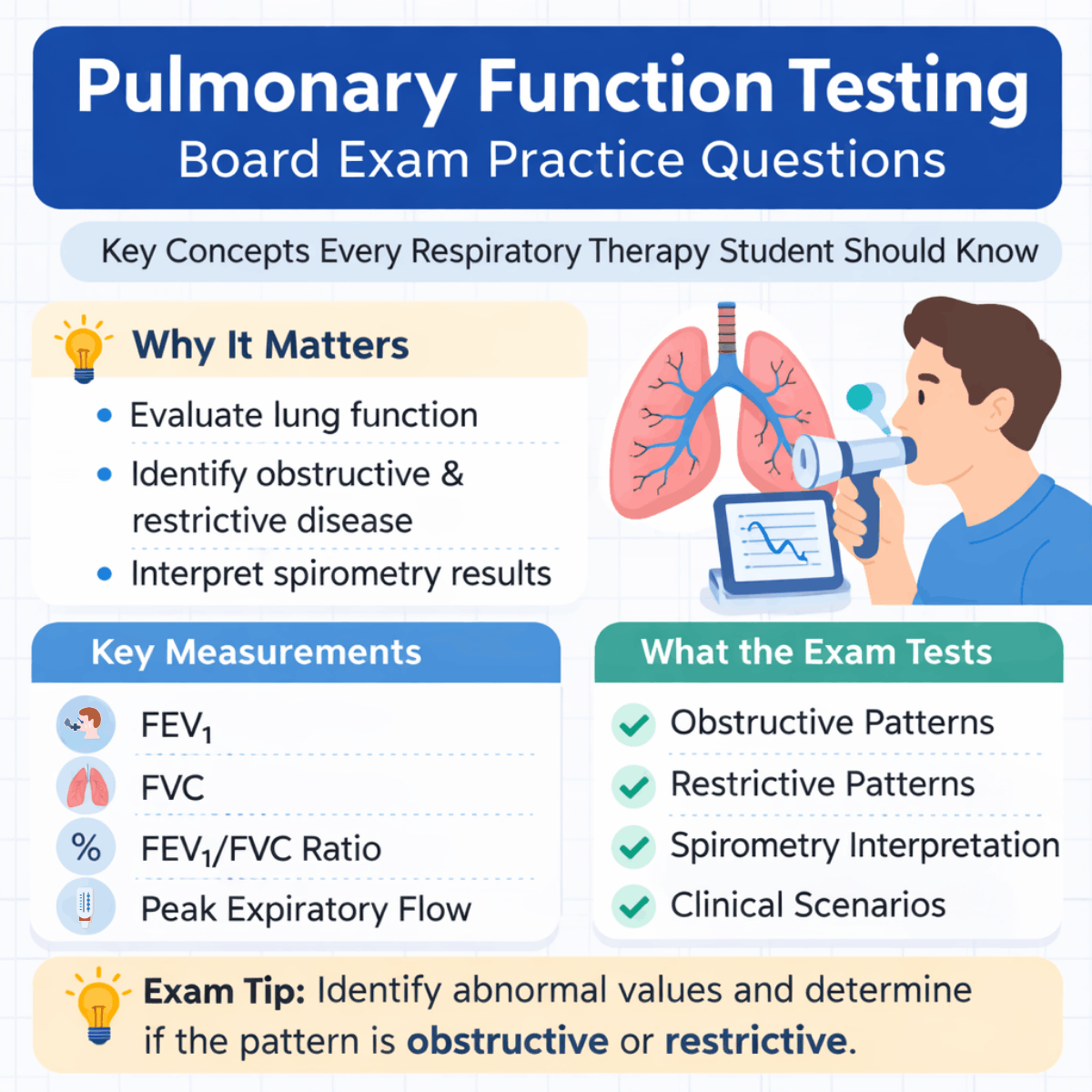
Pulmonary function testing (PFT) is an essential topic for respiratory therapy students preparing for the board exam. It evaluates your ability to interpret lung volumes, flow rates, and spirometry results to identify obstructive and restrictive lung diseases.
Questions related to PFTs often require you to analyze values such as FEV₁, FVC, and the FEV₁/FVC ratio while recognizing patterns associated with different respiratory conditions. Developing a strong understanding of these concepts will help you confidently answer exam questions and apply this knowledge in clinical practice.
The following pulmonary function testing board exam practice questions are designed to strengthen your understanding and reinforce the key principles you must know.
Note: We intentionally did not include the correct answers on this page so you can challenge yourself and assess your understanding of the material. If you’d like to access the correct answers and detailed explanations, you can download the digital study guide using the link below.

Access our quiz with sample TMC practice questions and detailed explanations to help you master pulmonary function testing (PFT).
Why Pulmonary Function Testing (PFT) Is Important for the Board Exam
Pulmonary function testing is an essential topic for the respiratory therapy board exam because it evaluates your ability to interpret lung function data and recognize patterns of respiratory disease. Many exam questions require you to analyze spirometry values, lung volumes, and flow rates to determine whether a patient has an obstructive or restrictive disorder.
You must also understand how to interpret measurements such as FEV₁, FVC, and the FEV₁/FVC ratio while recognizing common clinical scenarios associated with conditions like COPD, asthma, and pulmonary fibrosis.
A strong understanding of pulmonary function testing allows you to connect numerical data with patient symptoms and treatment decisions. Mastering these concepts will help you answer exam questions accurately and apply the same skills when evaluating patients in clinical practice.
Pulmonary Function Testing Board Exam Practice Questions
These pulmonary function testing practice questions are designed to help you review key concepts that commonly appear on the respiratory therapy board exam.
Use them to test your understanding of spirometry, lung volumes, and disease patterns while strengthening your clinical reasoning skills.
1. After reviewing the results of a patient’s pulmonary function tests, you note that the FEV1, FVC, and total lung capacity are all reduced. The FEV1/FVC ratio is normal. What is the interpretation based on these findings?
A. Restrictive lung disease
B. Obstructive lung disease
C. Combined obstructive-restrictive lung disease
D. The test is invalid
2. While reviewing the patient’s medical record, you note that the FEV1/FVC ratio is reported as being severely reduced. Which of the following is most consistent with this finding?
A. Pulmonary hypertension
B. Morbid obesity
C. Chronic asthma
D. Pneumonia
3. Your patient has an FEV1/FVC ratio that is lower than predicted. Her forced vital capacity is also lower than normal as well. What is the most likely cause of these findings?
A. A restrictive lung disease
B. An obstructive lung disease
C. Combined obstructive and restrictive lung disease
D. Normal test results
4. You are assessing a patient with chronic asthma. She has an SVC of 3,500 mL and an FVC of 2,500 mL. Which of the following best explains this difference?
A. Increased compliance during a forced expiration
B. Poor instruction by the previous respiratory therapist
C. Muscle fatigue during a forced expiration
D. Air trapping during a forced expiration
5. What percentage of the forced vital capacity should a patient with normal lungs be able to exhale within the first second of the maneuver?
A. 35-50% of the FVC
B. 50-70% of the FVC
C. 70-83% of the FVC
D. 84-93% of the FVC
6. Simple spirometry can be used to measure any of the following EXCEPT:
A. Tidal volume
B. Vital capacity
C. Inspiratory reserve volume
D. Residual volume
7. Upon the assessment of a patient receiving volume control AC ventilation, you observe a flow-volume loop with a sawtooth pattern on exhalation. Which of the following actions would help this patient the most?
A. Switch to pressure control ventilation
B. Administer a bronchodilator
C. Increase the endotracheal tube cuff pressure
D. Assess the patient’s need for suctioning
8. Your patient is a healthy male with an average body size. What would be considered the normal vital capacity range for this patient?
A. 2000 to 3000 mL
B. 3000 to 4000 mL
C. 4000 to 5000 mL
D. 5000 to 6000 mL
9. The amount of gas that can be inhaled above the volume that is normally inhaled during quiet breathing is called what?
A. FRC
B. ERV
C. IRV
D. VC
10. After reviewing your work order for the day, you notice that you have a patient with chronic bronchitis and another patient with emphysema. Which of the following PFT findings would you expect for these patients?
A. Increased lung compliance
B. Decreased forced expiratory flows
C. Decreased total lung capacity
D. Decreased diffusing capacity
11. If you were to take the total of the maximum volume of air that can be exhaled from the maximum inspiratory level, this can be defined as which of the following?
A. Residual volume
B. Expiratory reserve volume
C. Vital capacity
D. Total lung capacity
12. Upon entering the patient’s room, you heard the physician instruct the patient to “inhale as deeply as possible and then blow out all of the air as hard as you can.” Which pulmonary function test is being performed?
A. IC
B. TLC
C. MVV
D. FVC
13. The patient is instructed to take a deep breath in and then exhale as quickly as possible. The fastest air movement is recorded. Which of the following tests is being measured?
A. Vital capacity
B. FEV1
C. FEF25-75%
D. Peak flow
14. You are instructing a patient on how to perform an FVC maneuver. After looking at the results of an attempt, you determine that it took too long for the patient to reach the peak expiratory flow. Before another attempt, which of the following instructions should you give the patient?
A. “Take a deeper breath.”
B. “Don’t hesitate.”
C. “Blast the air out faster.”
D. “Blow out longer.”
15. Other than obtaining the results from a vital capacity maneuver, what else should be obtained and noted from the patient?
A. The patient’s resting minute ventilation
B. The patient’s height, gender, and age
C. The patient’s heart rate before/after testing
D. The patient’s actual and predicted body weight

Take our free course to learn essential tips, insights, and strategies to pass the TMC Exam on your first (or next) attempt.
16. You are instructing a patient on how to perform an FVC maneuver. After looking at the results of an attempt, you determine that the back extrapolated volume is excessive. Before another attempt, which of the following instructions should you give the patient?
A. “Take a deeper breath.”
B. “Don’t hesitate.”
C. “Blast the air out faster.”
D. “Blow out longer.”
17. You have been monitoring the vital capacity and maximum inspiratory pressure readings over the last 4 hours of a 39-year-old female patient that is receiving mechanical ventilation. The values have steadily decreased over this time period. How should this be interpreted?
A. Her condition is worsening
B. She has undiagnosed asthma
C. Her strength is improving
D. She is not giving her best effort
18. A comatose patient in the ICU is receiving mechanical ventilation. Taking this into consideration, which of the following pulmonary function tests can be performed on this patient?
A. Peak Expiratory Flow
B. Maximum Voluntary Ventilation
C. Maximum Inspiratory Pressure
D. Forced Expiratory Volume in 1 Second
19. The results of a bedside spirometry test that was performed on a patient reveals the following:
Respiratory rate = 19
Tidal volume = 380 mL
Dead space = 145 mL
Vital capacity = 1.1 L
Based on these results, what is the patient’s minute ventilation?
A. 3.4 L/min
B. 4.7 L/min
C. 7.2 L/min
D. 21.3 L/min
20. You are called to measure the strength of a patient’s respiratory muscles at the bedside. Which of the following devices would you select?
A. Pressure manometer
B. Peak flowmeter
C. Ergometer
D. Respirometer
21. A 56-year-old female patient’s bedside spirometry results are as follows:
FVC is decreased
FEV1 is normal
FEV1% is increased
What is the most likely problem?
A. Normal results
B. An obstructive disease
C. Poor patient effort
D. A restrictive disease
22. You are scheduled to perform a methacholine challenge on a female patient. What percent decrease in FEV1 needs to occur in order to conclude that a methacholine challenge is positive for airway hyperreactivity?
A. 10%
B. 15%
C. 20%
D. 25%
23. Your patient has the following PFT results below:
Vital Capacity 54% of predicted
FEV1 76% of predicted
FEV1/FVC ratio 82% of predicted
Peak Flow 119% of predicted
Total Lung Capacity 65% of predicted
Which of the following would be the best interpretation of the results?
A. Restrictive disease only
B. Obstructive disease only
C. Bronchitis
D. Mixed restrictive and obstructive disease
24. You just obtained a peak flow measurement of 3.7 L/sec on a 39-year-old male who is 5 feet 9 inches tall. What is the interpretation of this test result?
A. The patient has poor gas distribution
B. The patient has decreased lung compliance
C. The patient’s peak flow is normal
D. The patient has an airflow obstruction
25. Using spirometry, you tested a 52-year-old female patient before and after a bronchodilator was given. The results show that her FEV1 increased from 62% to 83% of predicted. What do these results indicate?
A. A fixed airway obstruction is present
B. The patient has normal diffusion capacity
C. The patient has a reversible airway obstruction
D. The patient has a restrictive process
26. While performing an MIP test on a 19-year-old female patient, she produces the following results after three attempts:
Attempt #1: -23 cm H2O
Attempt #2: -42 cm H2O
Attempt #3: -14 cm H2O
Which of the following best explains the patient’s results?
A. There is a leak at the mouthpiece
B. The patient has an obstructive disease
C. The patient has a restrictive disease
D. The patient isn’t giving a good effort
27. You are about to perform pulmonary function tests on a 52-year-old male patient. Before you begin, the patient mentioned that he smoked 3 cigarettes in the past two hours. Which of the following tests would be affected by this finding?
A. FVC
B. FRC
C. Raw
D. Lung Diffusion
28. Which of the following bedside measurements is considered to be the best for assessing the function of the respiratory muscles and mechanical properties of the lungs?
A. Functional residual capacity
B. Vital capacity
C. Maximum inspiratory force
D. Minute ventilation
29. A 29-year-old female patient with suspected asthma needs to undergo pulmonary function testing to confirm the diagnosis. Which of the following tests would be the least helpful in this situation?
A. Lung diffusion study
B. Flow-volume loop
C. Bronchoprovocation testing
D. Pre- and post-bronchodilator testing
30. While reviewing the results of a forced vital capacity maneuver of an adult male patient, you note that an S-shaped curve appears on the flow-volume graph. This most likely indicates which of the following?
A. The patient stopped exhalation too soon
B. The patient was coughing during the attempt
C. The patients was breathing too fast during the attempt
D. The patient gave poor effort at the start of the breath
31. You are about to perform a pulmonary function test on a 65-year-old male patient after providing a bronchodilator breathing treatment. It is suspected that the patient has COPD. His results are as follows:
FEV1/FVC ratio = 64%
FEV1 = 86% predicted
How would you characterize this patient?
A. Normal
B. Mild COPD
C. Moderate COPD
D. Severe COPD
32. Your patient is about to perform a Maximum Expiratory Pressure test. Which of the following instructions should you give to the patient?
A. “Take a normal breath in, then blow out hard.”
B. “Inhale as much as you can, then blow out hard.”
C. “Exhale normally, then inhale as hard as possible.”
D. “Blow out all of your air before you begin.”
33. A 54-year-old female patient’s spirometry results show an FEV1 that is calculated to be 80% of her forced vital capacity. This finding suggests that the patient probably has which of the following?
A. Chronic bronchitis
B. Emphysema
C. An obstructive lung disease
D. Clinically normal values
34. A 49-year-old male patient has a vital capacity of 3400 mL, a functional residual capacity of 4600 mL and an expiratory reserve volume of 1400 mL. What is his residual volume?
A. 8700 mL
B. 2100 mL
C. 3200 mL
D. 5800 mL
35. A patient performs an FVC maneuver and displays the following results:

How would you interpret this flow-volume loop tracing?
A. Normal lungs
B. Small airway obstruction
C. Large airway obstruction
D. Restrictive disease
Access our quiz with sample TMC practice questions and detailed explanations to help you master pulmonary function testing (PFT).
Final Thoughts
Pulmonary function testing is a fundamental skill for respiratory therapists and an important topic to understand when preparing for the board exam. Being able to interpret spirometry results, recognize obstructive and restrictive patterns, and analyze key values such as FEV₁, FVC, and the FEV₁/FVC ratio will help you answer exam questions with confidence.
By practicing questions like the ones in this article, you can reinforce your understanding of pulmonary function testing and identify areas that need additional review.
Consistent practice and a strong grasp of these concepts will not only improve your exam performance but also prepare you to interpret pulmonary function data effectively in real clinical situations.

Written by:
John Landry is a registered respiratory therapist from Memphis, TN, and has a bachelor's degree in kinesiology. He enjoys using evidence-based research to help others breathe easier and live a healthier life.
References
- Ponce MC, Sankari A, Sharma S. Pulmonary Function Tests. [Updated 2023 Aug 28]. In: StatPearls [Internet]. Treasure Island (FL): StatPearls Publishing; 2026.